Math is learned the way music is: by practicing, a lot.
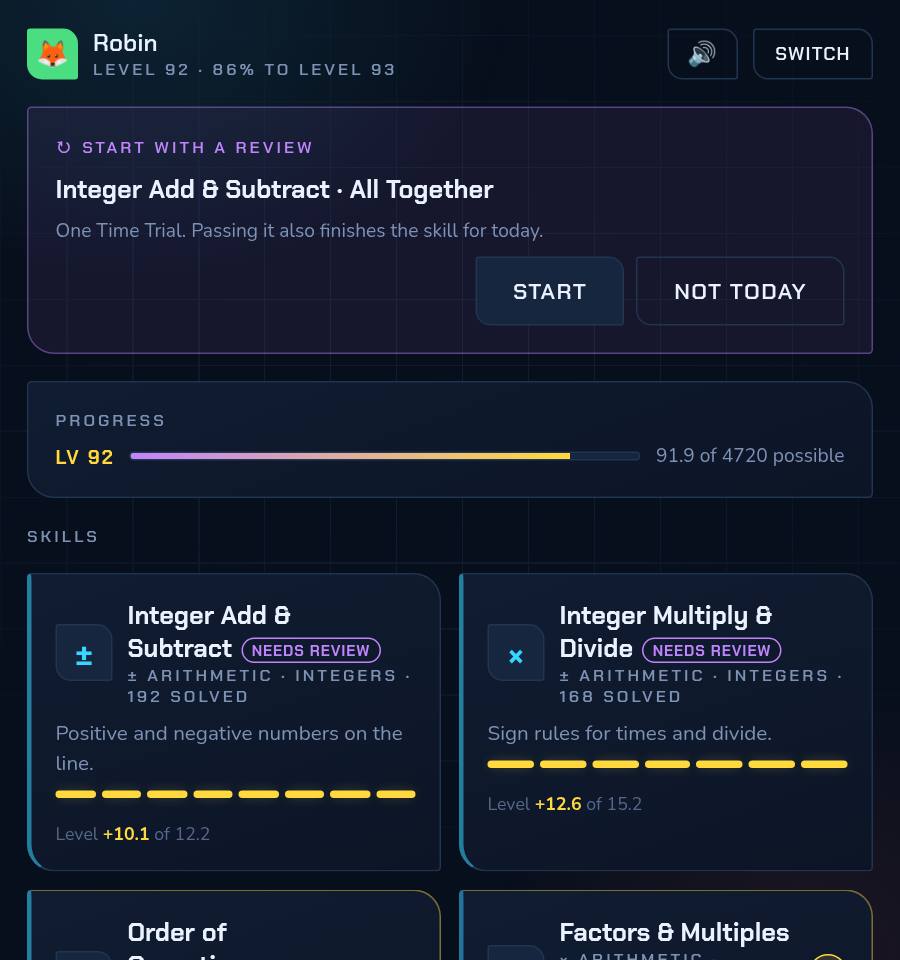
Versine Math is daily math practice, from integer arithmetic through trigonometry, logarithms and series. A student works on one skill until they really have it, proves it against the clock, and keeps it, because Versine brings it back for review weeks and months later.
Free for 14 days. A card is needed to start, and nothing is charged during the trial. See the plans and how renewal works.
For now, Versine is available only in Utah: you’ll need a billing address there. We’re adding other states one at a time.
What Versine is
- 88 skills, from pre-algebra on
- 665 levels, each teaching one idea
- 540,000+ problems, every answer checked
- A path through the math that comes before calculus. Integers, fractions and equations; algebra and functions; geometry, probability and statistics; then trigonometry, logarithms, vectors, complex numbers and series. Each skill opens on the student’s map once the skills it builds on are finished.
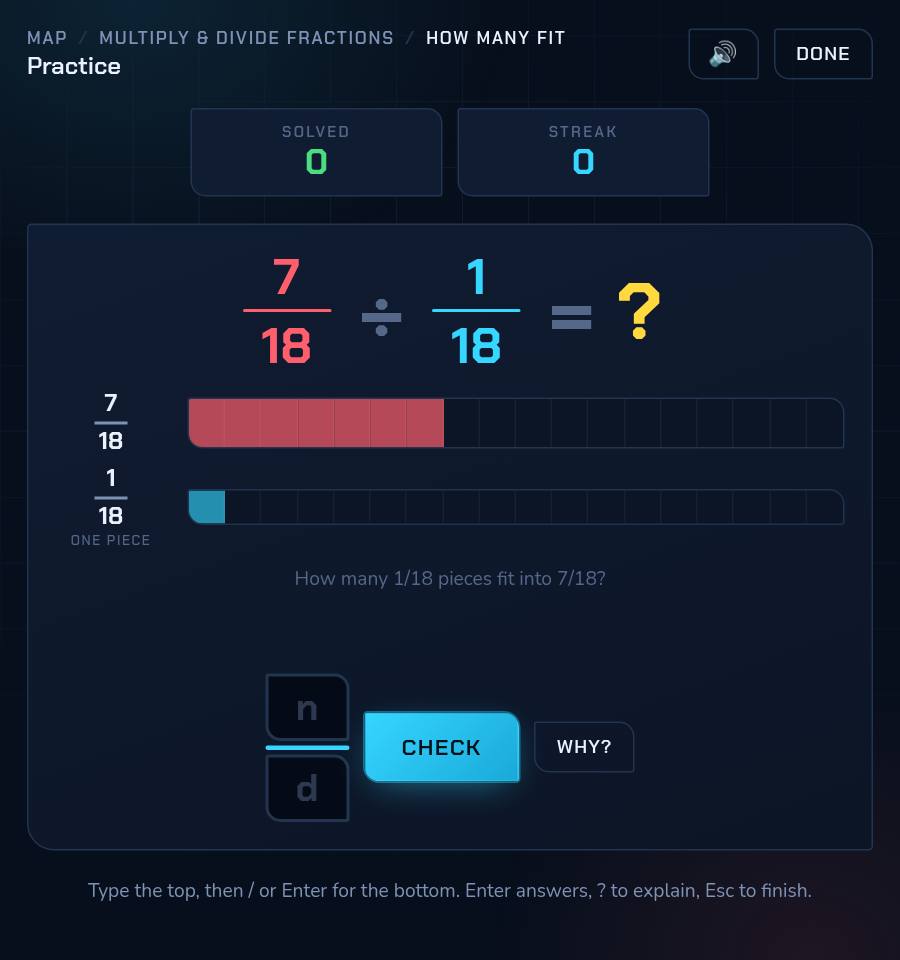
- One idea at a time. A skill is a short ladder of levels. In Practice there’s no clock, a worked example whenever the student asks why, and anything they miss comes back a few problems later. When it feels easy, a short Time Trial proves it and opens the next level.
- Kept, not crammed. A finished skill comes back for review after 7 days, then 14, 30, 60 and 120, so what was learned in September is still there in May.
There’s no shortcut. That’s the point.
No app, video or trick makes math easy. A musician gets good by playing scales every day until their hands know them without thinking, and math works the same way. Understanding comes first, and every level explains its idea with a worked example. But it’s practice, a great deal of it, that makes a skill quick and lasting, so the next skill has something solid to stand on.
That’s why Versine is built around a library of more than 540,000 problems. There are enough that a student can practice every day for years and keep meeting new ones, and every answer is checked by a second program that solves each problem again from scratch, and checks them all again whenever the library changes. How Versine works, in full.
What we ask of your family: 30 minutes, every weekday
Versine works when each student practices for at least 30 minutes every weekday. That’s the whole deal, and it’s the part only you can make happen.
Few students will choose it on their own, any more than they’d choose to practice the piano. So make it a requirement, like homework: the same time each day, before screens and games. You don’t need to know the math yourself. Your job is the habit; Versine’s is the teaching, the practice and the record of it.
If 30 minutes a weekday isn’t going to happen in your house right now, Versine may not be the right fit yet, and the free trial is a fair way to find out. What a good week looks like.
How a family uses it
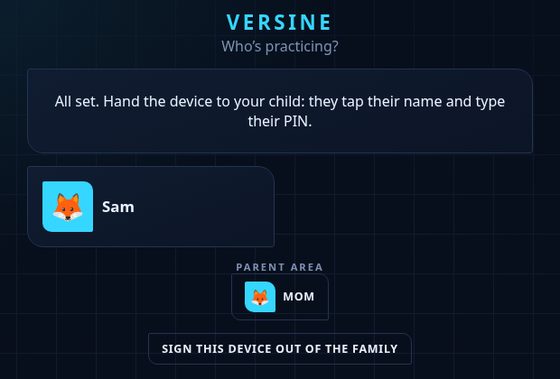
- One account for the family. A parent or legal guardian sets it up and pays for it.
- Each child has their own profile and PIN, so several children can share a device and keep their own progress.
- Parents have an area of their own, where you can see each student's progress and when they last practiced, and manage the account.
Who it's for
Families who want their children to get solid at math and will make the time for it, including homeschool families. An adult learner can have an account of their own.
Open source, for anyone who wants to run it themselves
The practice software at the heart of Versine is open source and free. Versine Community Edition is MIT licensed and is meant to run on a server you look after yourself: the same skills and the same library of problems. We want this kind of practice to be available to as many children as possible, so if you have a home server and you’re up to running it, please do.
The paid service is for families who'd rather not. We run the server, back it up, keep it up to date and answer your questions, so all you do is sign in. Subscriptions are also what keep Versine going: they pay for the work of adding skills and problems, and for bringing it to more families. More about the open-source edition.
What we do with your child's information
We collect what we need to teach them and show you their progress. We don't sell it, and there are no ads in the app. If your child is under 13, we ask for your consent by email before we collect anything about them. Read our Privacy policy.